
The Solution
Family Reunification:
Family reunification is the key to solving the Orphan Crisis.
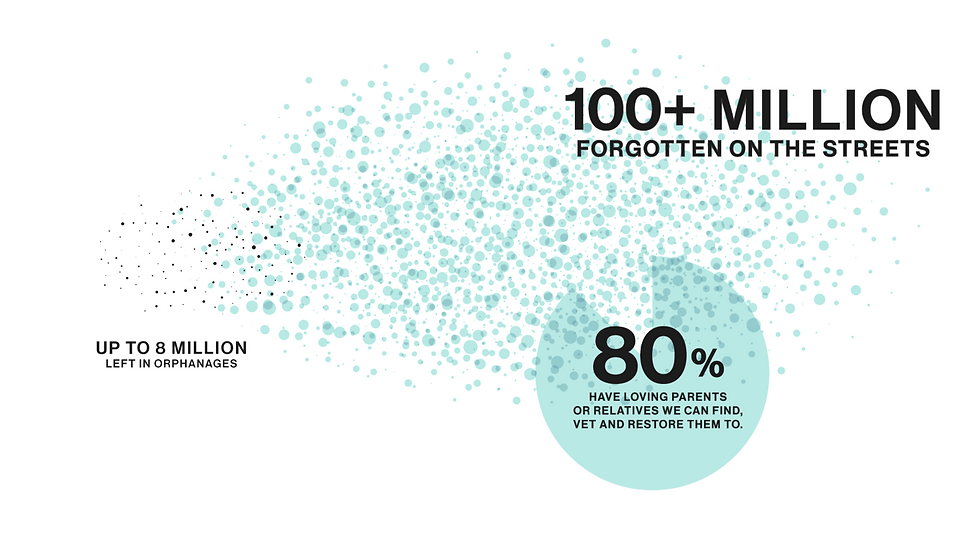
In developing nations such as Kenya, many children are placed in orphanages due to poverty, even though they still have living parents or relatives. About 80% of children living as orphans have relatives, but most money goes to funding orphanages. This money should be distributed to support families living in poverty. If children could remain in loving families, their brain development would be significantly improved because of the access to a primary caregiver.
For children who are already living as orphans, family reunification can be implemented through select organizations that help to build up families to receive their children back. In the US, many children bounce around from home to home, with Foster Care becoming a permanent solution. Foster care should be viewed as a temporary solution where children are kept safe until their parents can take care of them again. Much of this has to do with adequately helping parents come to a place where they can care for their child/children again while also providing excellent support and instruction for temporary Foster parents.
When family reunification is not available, adoption should be the last option. Adoption still incorporates a child being a part of a loving family, which is very important.
1 Million Home. 1millionhome.com/. Accessed 15 Apr. 2024.

01
Reunification Through Foster Care
The ultimate goal of any foster care system should be to reunify children who have been displaced from their homes for their safety with their biological parent(s). In cases where reunification with the parents is not possible, relatives of the children should first be sought, and if that is not possible, a more permanent home for the child should be found. A big problem with many foster care systems in the constant removing of children from homes, hindering their connection with a primary caregiver which ultimately disrupts brain development.
02
Reunification Without the Foster Care System
There is still much hope in the reunification process in countries without foster care systems. To help reunify children with their biological parents or relatives, we first need to examine the sheer number of orphanages in many countries.
Contrary to popular belief, governments are trying to eliminate the use of orphanages. UNICEF and Save the Children are working on ending such harsh institutionalization of children. The state does not fund most orphanages but instead privately runs them to earn money from donations.
With massive amounts of donations from people overseas, tourists, and people giving with good intentions, private orphanages continue to exploit children for profit. Money being sent to these orphanages should be redirected to help support families. Being in a family is the best thing you can do for a child despite financial hardship.
Reunification can be made possible through several organizations and non-profits that help connect children with their families and provide check-ups to ensure the child is safe to return home.

03
Adoption

Linder, Jannik. "Foster Care Reunification Statistics (Fresh Research)." Gitnux, 16 Dec. 2023, gitnux.org/ foster-care-reunification-statistics/. Accessed 16 Apr. 2024.
There are still many cases when reunification is not the best option for a child, and there can be many reasons for this. In certain cases, trying to reunify a child with their relatives can be very difficult and hinder the child from being placed in a permanent home through adoption. It all comes down to what serves the child and what is optimal for their brain development.
The paramount goal should always be to find a permanent solution when a child is uprooted from their home, whether that entails reunification or adoption. Reunification is typically the initial goal, but when the process becomes grueling, spanning years and leading to the child's repeated displacement, we must question whether it truly serves the child's best interests to persist with reunification.
In cases where reunification is not possible or near impossible, adoption is the best solution. No child should remain in the foster care system, or in an orphanage until they age out at 18. When a child enters their adult life with no family, they are bound to have overwhelmingly more problems than if they did. Placing a displaced child in a permanent family must be the goal, and any other alternatives with result in a underdeveloped brain.
04
Poverty Should Not Prevent Family
Poverty is never the only problem in family breakdown; therefore, the solution is not only financial.
Many family breakdowns come from relational problems that require relational solutions.
Thousands of children who were on the streets and in orphanages go home to poor families and communities every year, meaning it's not only because of poverty that they end up as orphans.
Poverty may make everything more complicated, but most poor families are resilient, and most children raised in poor but loving families are much more resilient. The proper development gained through being raised in a loving family allows one to become a functional and independent adult versus those raised in better-funded orphanages.
PROVIDING EMPOWERMENT FOR PARENTS
Reunification is rarely a straightforward, smooth-sailing process because displacement has to occur at some point before reunification occurs. Displacement is often a very traumatizing event for children. To put it into context, they are being forcefully removed from their home and their parent(s). A displaced child then enters a realm of uncertainty where it is hard to trust any adult. Whether a child is placed into an orphanage or placed in the foster care system, they experience trauma and continue to experience very high levels of stress.
The trauma a child experiences in displacement does not go away quickly or easily when they reenter family life. Many children in the U.S. Foster Care System have twice the amount of PTSD as war veterans, which points to the fact that overcoming trauma is no easy task.
With all of this in mind, it is very important to consider the overwhelming task parents are taking on when they are reunified with their child, fostering a child, or adopting a child. Therefore, it is important for parents to have the proper education, empowerment, and resources they need to take care of their children properly.
One Method of education and empowerment for parents is understanding Trust-Based-Relational-Intervention (TBRI). TBRI is a way of meeting children's many needs through a lens of attachment and trauma-informed care. The key point of TBRI is a connection to the child who has experienced trauma while also deeply understanding the child's sensory processing, neuroscience, and years of attachment. TBRI can be offered through the book (The Connected Child), videos, a course, or through practitioner training (available for professionals through application).
"Trust-Based Relational Intervention." Karyn Purvis Institute of Child Development, child.tcu.edu/about-us/tbri/ #sthash.Emwf13io.6qKmBbMI.dpbs. Accessed 16 Apr. 2024.

Linder, Jannik. "Foster Care Reunification Statistics (Fresh Research)." Gitnux, 16 Dec. 2023, gitnux.org/ foster-care-reunification-statistics/. Accessed 16 Apr. 2024.
Why Reunification?
click the link below to watch video
1 Million Home. 1millionhome.com/. Accessed 15 Apr. 2024.
What Can We Do?
Although most people do not make laws and polices, there is still a lot everyone can do to make change happen!
Stopping Orphanage Tourism -
-
With over $3 billion of international donations funding orphanages every year, money should be redirected to repurpose orphanages into centers of street kid rescue, trauma rehabilitation and family restoration. Pioneering organizations like 1MILLIONHOME are proving this at scale. Preserving and restoring a family is always in the best interests of a child, and this should be the goal of all charity and aid. If you give any money to privately funded orphanages, you should do more research and make sure any orphanage you donate to prioritizes family. If you are looking to volunteer while traveling, you should also do research before volunteering for any child care facility.
The Problem with Volunteering -
-
Volunteering at orphanages can cause there to be a "demand for orphans." When there is a demand for orphans it is possible for children to be recruited to be put in orphanages. There are even children who are trafficked to live in corrupt orphanages that want support from donors.
-
It is very easy for international visitors to volunteer at orphanages without proper screening which poses risk to children who are exposed to strangers.
-
Volunteers can cause an increase in attachment disorders because children can attach to volunteers that will leave quickly.
-
With these facts in mind, do your research before volunteering, and explore other options of volunteer work.
-
Advocacy -
-
Advocacy can be a great tool to spread awareness on the orphan crisis. With tools like social media it is easy to spread important information regarding the topic, and encouraging people to support the cause.
Supporting the Right Organizations